HAMLET OR F.O.M.O.
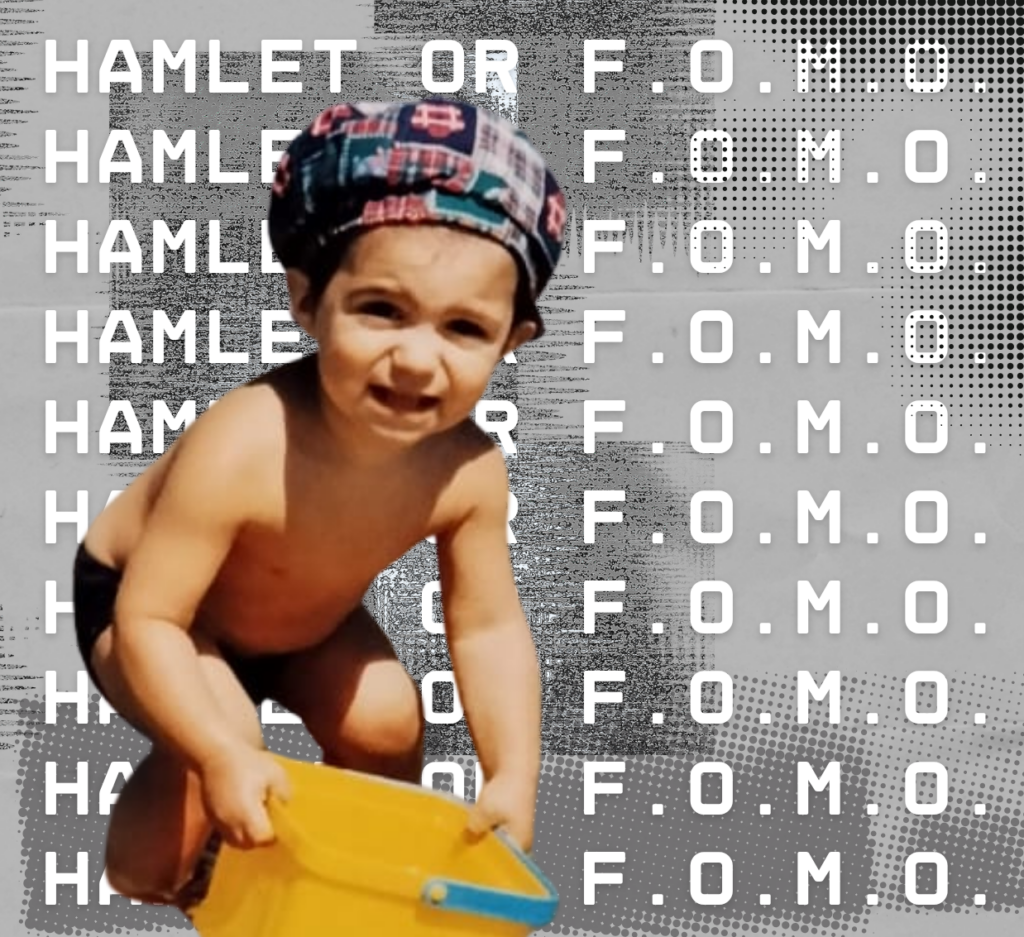
Do I dare
disturb the
Universe?
Breathe!
I am not
the Prince Hamlet
and this is not
a love song.
– Filippo.
-E SONG
ITA
Il canto d’amore di J. Alfred Prufrock
Io sono filippo e questo è un canto d’amore.
No! io non sono filippo e questo non è un canto d’amore!
É il canto di tutti i j.alfred prufrock: persone moderne, persone paralizzate, Persone che hanno paura di invecchiare, paura dei giudizi della gente, paura di dire parole d’amore. Persone che si sentono spesso fuori posto, che guardano scorrere la vita temporeggiando e posticipando una decisione importante.
Paralizzati.
E allora… basta camminare
Camminiamo per i quartieri nebbiosi perchè in fondo tu ed io conteniamo nel cuore le stesse domande.
“Allora andiamo, tu ed io, Quando la sera si stende contro il cielo Come un paziente anestetizzato disteso su una tavola; Andiamo, per certe strade semideserte, Mormoranti ricoveri Di notti senza riposo in alberghi di passaggio a poco prezzo E ristoranti pieni di segatura e gusci d’ostriche; Strade che si succedono come un noioso argomento Con l’insidioso proposito Di condurti a domande che opprimono…
Oh, non chiedere «Cosa?» Andiamo a fare la nostra visita.
Nella stanza le donne vanno e vengono Parlando di Michelangelo.
[…]
E di sicuro ci sarà tempo
[…]
Per prepararti una faccia per incontrare le facce che incontri; Ci sarà tempo per uccidere e creare, E tempo per tutte le opere e i giorni delle mani Che sollevano e lasciano cadere una domanda sul tuo piatto; Tempo per te e tempo per me, E tempo anche per cento indecisioni, E per cento visioni e revisioni, Prima di prendere un tè col pane abbrustolito
Nella stanza le donne vanno e vengono Parlando di Michelangelo.
E di sicuro ci sarà tempo
Di chiedere, «Posso osare?» e, «Posso osare?»
Tempo di volgere il capo e scendere la scala, Con una zona calva in mezzo ai miei capelli Con il mio abito per la mattina, con il colletto solido che arriva fino al mento
Perché già tutte le ho conosciute, conosciute tutte: – Ho conosciuto le sere, le mattine, i pomeriggi, Ho misurato la mia vita con cucchiaini da caffè; Conosco le voci che muoiono con un morente declino Sotto la musica giunta da una stanza più lontana. Così, come potrei rischiare? E ho conosciuto tutti gli occhi, conosciuti tutti – Gli occhi che ti fissano in una frase formulata, E quando sono formulato, appuntato a uno spillo, Quando sono trafitto da uno spillo e mi dibatto sul muro Come potrei allora cominciare A sputar fuori tutti i mozziconi dei miei giorni e delle mie abitudini? Come potrei rischiare? E ho già conosciuto le braccia, conosciute tutte – Le braccia ingioiellate e bianche e nude […] Braccia appoggiate a un tavolo, o avvolte in uno scialle. Potrei rischiare, allora?- Come potrei cominciare?
Direi, ho camminato al crepuscolo per strade strette Ed ho osservato il fumo che sale dalle pipe D’uomini solitari in maniche di camicia affacciati alle finestre?
Avrei potuto essere un paio di ruvidi artigli Che corrono sul fondo di mari silenziosi
[…]
Potrei, dopo il tè e le paste e i gelati, aver la forza di forzare il momento alla sua crisi?
Ma sebbene abbia pianto e digiunato, pianto e pregato,
Sebbene abbia visto il mio capo (che comincia un po’ a perdere i capelli) Portato su un vassoio, lo non sono un profeta – e non ha molta importanza; Ho visto vacillare il momento della mia grandezza, E ho visto l’eterno Lacchè reggere il mio soprabito ghignando, E a farla breve, ne ho avuto paura.
E ne sarebbe valsa la pena, dopo tutto, Dopo le tazze, la marmellata e il tè, E fra la porcellana e qualche chiacchiera Fra te e me, ne sarebbe valsa la pena D’affrontare il problema sorridendo, Di comprimere tutto l’universo in una palla E di farlo rotolare verso una domanda che opprime, Di dire: « lo sono Lazzaro, vengo dal regno dei morti, Torno per dirvi tutto, vi dirò tutto » – Se una, mettendole un cuscino accanto al capo, Dicesse: « Non è per niente questo che volevo dire. Non è questo, per niente. » E ne sarebbe valsa la pena, dopo tutto, Ne sarebbe valsa la pena, Dopo i tramonti e i cortili e le strade spruzzate di pioggia, Dopo i romanzi, dopo le tazze da tè, dopo le gonne strascicate sul pavimento E questo, e tante altre cose? – E’ impossibile dire ciò che intendo! Ma come se una lanterna magica proiettasse il disegno dei nervi su uno schermo: Ne sarebbe valsa la pena Se una, accomodandosi un cuscino o togliendosi uno scialle, E volgendosi verso la finestra, dicesse: « Non è per niente questo, Non è per niente questo che volevo dire. »
No! lo non sono il Principe Amleto, né ero destinato ad esserlo; Io sono un cortigiano, sono uno Utile forse a ingrossare un corteo, a dar l’avvio a una scena o due, Ad avvisare il principe; uno strumento facile, di certo, Devoto, felice di mostrarsi utile, Prudente, cauto, meticoloso; Pieno di nobili sentenze, ma un po’ ottuso; Talvolta, in verità, quasi ridicolo – E quasi, a volte, il Buffone.
Divento vecchio… divento vecchio… Porterò i pantaloni arrotolati in fondo.
Dividerò i miei capelli sulla nuca? Avrò il coraggio di mangiare una pesca? Porterò pantaloni di flanella bianca, e camminerò sulla spiaggia.
Ho udito le sirene cantare l’una all’altra.
Non credo che canteranno per me.
Le ho viste al largo cavalcare le onde Pettinare la candida chioma delle onde risospinte: Quando il vento rigonfia l’acqua bianca e nera.
Ci siamo troppo attardati nelle camere del mare Con le figlie del mare incoronate d’alghe rosse e brune Finché le voci umane ci svegliano, e anneghiamo.” T.S. Eliot
SLO
Ljubezenska pesem J. Alfreda Prufrocka
Jaz sem Filippo in to je ljubezenska pesem.
Ne! Jaz nisem Filippo in to ni ljubezenska pesem!
To je pesem vseh J. Alfredov Prufrockov: sodobnih ljudi, paraliziranih ljudi. Ljudi, ki se bojijo staranja, bojijo se sodb drugih, bojijo se izreči besede ljubezni. Ljudi, ki se pogosto počutijo, kot da ne sodijo nikamor, ki opazujejo življenje, kako teče mimo njih, medtem ko oklevajo in odlagajo pomembno odločitev.
Paralizirani.
In torej … vse, kar moramo storiti, je hoditi.
Hodimo po meglenih ulicah, saj navsezadnje ti in jaz v svojih srcih nosiva ista vprašanja.
«Pojdiva torej, ti in jaz,
ko se večer razprostre proti nebu
kakor anesteziran bolnik, iztegnjen na mizi;
pojdiva skozi napol zapuščene ulice,
mrmrajoča zatočišča
nemirnih noči v cenenih hotelih za eno noč
in restavracijah, polnih žagovine in ostriginih lupin;
ulice, ki si sledijo kakor dolgočasen argument
s prikritim namenom,
da te pripeljejo do vprašanj, ki težijo …
Oh, ne sprašuj: »Kaj?«
Pojdiva na obisk.
V sobi ženske prihajajo in odhajajo
in govorijo o Michelangelu.
[…]»
In zagotovo bo še čas
[…]
Da si pripraviš obraz za obraze, ki jih srečuješ;
čas bo za ubijanje in ustvarjanje,
in čas za vsa dela in dneve rok,
ki dvigajo in spuščajo vprašanje na tvoj krožnik;
čas zate in čas zame,
in čas tudi za sto neodločnosti,
za sto videnj in ponovnih premislekov,
preden spijemo čaj s popečenim kruhom.
V sobi ženske prihajajo in odhajajo
in govorijo o Michelangelu.
In zagotovo bo še čas
Da se vprašam: »Si upam?« in »Si upam?«
Čas, da obrnem glavo in se spustim po stopnicah,
z zaplato pleše sredi las,
v svoji jutranji obleki, s trdim ovratnikom, ki sega do brade.
Kajti vse sem že poznal, vse sem poznal:
poznal sem večere, jutra, popoldneve,
svoje življenje sem odmerjal s kavnimi žličkami;
poznam glasove, ki ugašajo v umirajočem pojemanju
pod glasbo, ki prihaja iz bolj oddaljene sobe.
Kako bi si torej lahko drznil?
In poznal sem vse oči, vse sem poznal –
oči, ki te ujamejo v izoblikovano frazo,
in ko sem izoblikovan, pripet na buciko,
ko sem preboden z buciko in se zvijam na steni,
kako bi potem lahko začel
izpljuvati vse ostanke svojih dni in svojih navad?
Kako bi si lahko drznil?
In poznal sem že roke, vse sem poznal –
roke, okrašene z nakitom, bele in gole […]
roke, položene na mizo ali ovite v šal.
Bi si torej lahko drznil? –
Kako bi lahko začel?
Naj rečem, da sem ob mraku hodil po ozkih ulicah
in opazoval dim, ki se dviga iz pip
osamljenih moških v srajčnih rokavih, nagnjenih skozi okna?
Lahko bi bil par grobih klešč,
ki hitijo po dnu tihih morij.
[…]
Bi lahko po čaju, pecivu in sladoledu zbral dovolj moči, da bi trenutek privedel do njegovega preloma?
Toda čeprav sem jokal in se postil, jokal in molil,
čeprav sem videl svojo glavo (ki že nekoliko izgublja lase), prineseno na pladnju, nisem prerok – in to niti ni tako pomembno; videl sem, kako je trenutek moje veličine omahnil, in videl sem večnega Lakaja, kako je s posmehljivim nasmehom držal moj plašč, in skratka, bilo me je strah.
In ali bi bilo navsezadnje vredno,
po skodelicah, marmeladi in čaju,
med porcelanom in kakšnim pogovorom
med tabo in mano, ali bi bilo vredno
z nasmehom se soočiti z vprašanjem,
stisniti vse vesolje v kroglo
in jo zakotaliti proti vprašanju, ki teži,
reči: »Jaz sem Lazar, prihajam iz kraljestva mrtvih,
vrnil sem se, da vam povem vse, povedal vam bom vse« –
če bi ona, ko bi si ob glavi namestila blazino,
rekla: »Sploh nisem mislila tega.
Sploh ne tega.«
In ali bi bilo navsezadnje vredno,
ali bi bilo vredno,
po sončnih zahodih in dvoriščih in ulicah, poškropljenih z dežjem,
po romanih, po skodelicah čaja, po krilih, ki se vlečejo po tleh,
in po vsem tem in toliko drugih stvareh? –
Nemogoče je povedati, kaj mislim!
Toda kakor da bi čarobna svetilka
na zaslon projicirala vzorec živcev:
ali bi bilo vredno,
če bi ona, ko bi si namestila blazino ali snela šal
in se obrnila proti oknu, rekla:
»Sploh ne gre za to,
sploh nisem tega hotela povedati.«
Ne! Jaz nisem princ Hamlet in tudi ni bilo usojeno, da bi to bil; sem dvorjan, eden tistih, ki morda pride prav, da poveča sprevod, začne prizor ali dva, svetuje princu; nedvomno priročno orodje, vdan, vesel, da je lahko koristen, preudaren, previden, natančen; poln vzvišenih misli, a nekoliko topoglav; včasih, resnici na ljubo, skoraj smešen – in skoraj, včasih, Norec.
Starim se … starim se …
Hlačnice bom nosil zavihane.
Naj si lase počešem nazaj?
Si bom upal pojesti breskev?
Nosil bom bele flanelaste hlače in hodil po plaži.
Slišal sem sirene, kako pojejo druga drugi.
Ne verjamem, da bodo pele zame.
Videl sem jih daleč na morju jezditi na valovih,
česati belo grivo valov, ki jih veter žene nazaj,
ko veter razburka belo in črno vodo.
Predolgo smo se zadržali v sobanah morja
z morskimi dekleti, okronanimi z rdečimi in rjavimi algami,
dokler nas človeški glasovi ne prebudijo – in utonemo.” T.S. Eliot
ENG
Il canto d’amore di J. Alfred Prufrock
I am Filippo, and this is a love song.
No! I am not Filippo, and this is not a love song!
It is the song of all the J. Alfred Prufrocks: modern people, paralysed people. People who are afraid of growing old, afraid of other people’s judgement, afraid of speaking words of love. People who often feel out of place, who watch life passing by while hesitating, postponing an important decision.
Paralysed.
And so… all we have to do is walk.
Let us walk through the foggy streets, because, after all, you and I carry the same questions in our hearts.
“Let us go then, you and I,
When the evening is spread out against the sky
Like a patient etherized upon a table;
Let us go, through certain half-deserted streets,
The muttering retreats
Of restless nights in one-night cheap hotels
And sawdust restaurants with oyster-shells:
Streets that follow like a tedious argument
Of insidious intent
To lead you to an overwhelming question …
Oh, do not ask, “What is it?”
Let us go and make our visit.
In the room the women come and go
Talking of Michelangelo.
The yellow fog that rubs its back upon the window-panes,
The yellow smoke that rubs its muzzle on the window-panes,
Licked its tongue into the corners of the evening,
Lingered upon the pools that stand in drains,
Let fall upon its back the soot that falls from chimneys,
Slipped by the terrace, made a sudden leap,
And seeing that it was a soft October night,
Curled once about the house, and fell asleep.
And indeed there will be time
For the yellow smoke that slides along the street,
Rubbing its back upon the window-panes;
There will be time, there will be time
To prepare a face to meet the faces that you meet;
There will be time to murder and create,
And time for all the works and days of hands
That lift and drop a question on your plate;
Time for you and time for me,
And time yet for a hundred indecisions,
And for a hundred visions and revisions,
Before the taking of a toast and tea.
In the room the women come and go
Talking of Michelangelo.
And indeed there will be time
To wonder, “Do I dare?” and, “Do I dare?”
Time to turn back and descend the stair,
With a bald spot in the middle of my hair —
(They will say: “How his hair is growing thin!”)
My morning coat, my collar mounting firmly to the chin,
My necktie rich and modest, but asserted by a simple pin —
(They will say: “But how his arms and legs are thin!”)
Do I dare
Disturb the universe?
In a minute there is time
For decisions and revisions which a minute will reverse.
For I have known them all already, known them all:
Have known the evenings, mornings, afternoons,
I have measured out my life with coffee spoons;
I know the voices dying with a dying fall
Beneath the music from a farther room.
So how should I presume?
And I have known the eyes already, known them all—
The eyes that fix you in a formulated phrase,
And when I am formulated, sprawling on a pin,
When I am pinned and wriggling on the wall,
Then how should I begin
To spit out all the butt-ends of my days and ways?
And how should I presume?
And I have known the arms already, known them all—
Arms that are braceleted and white and bare
(But in the lamplight, downed with light brown hair!)
Is it perfume from a dress
That makes me so digress?
Arms that lie along a table, or wrap about a shawl.
And should I then presume?
And how should I begin?
Shall I say, I have gone at dusk through narrow streets
And watched the smoke that rises from the pipes
Of lonely men in shirt-sleeves, leaning out of windows? …
I should have been a pair of ragged claws
Scuttling across the floors of silent seas.
And the afternoon, the evening, sleeps so peacefully!
Smoothed by long fingers,
Asleep … tired … or it malingers,
Stretched on the floor, here beside you and me.
Should I, after tea and cakes and ices,
Have the strength to force the moment to its crisis?
But though I have wept and fasted, wept and prayed,
Though I have seen my head (grown slightly bald) brought in upon a platter,
I am no prophet — and here’s no great matter;
I have seen the moment of my greatness flicker,
And I have seen the eternal Footman hold my coat, and snicker,
And in short, I was afraid.
And would it have been worth it, after all,
After the cups, the marmalade, the tea,
Among the porcelain, among some talk of you and me,
Would it have been worth while,
To have bitten off the matter with a smile,
To have squeezed the universe into a ball
To roll it towards some overwhelming question,
To say: “I am Lazarus, come from the dead,
Come back to tell you all, I shall tell you all”—
If one, settling a pillow by her head
Should say: “That is not what I meant at all;
That is not it, at all.”
And would it have been worth it, after all,
Would it have been worth while,
After the sunsets and the dooryards and the sprinkled streets,
After the novels, after the teacups, after the skirts that trail along the floor—
And this, and so much more?—
It is impossible to say just what I mean!
But as if a magic lantern threw the nerves in patterns on a screen:
Would it have been worth while
If one, settling a pillow or throwing off a shawl,
And turning toward the window, should say:
“That is not it at all,
That is not what I meant, at all.”
No! I am not Prince Hamlet, nor was meant to be;
Am an attendant lord, one that will do
To swell a progress, start a scene or two,
Advise the prince; no doubt, an easy tool,
Deferential, glad to be of use,
Politic, cautious, and meticulous;
Full of high sentence, but a bit obtuse;
At times, indeed, almost ridiculous—
Almost, at times, the Fool.
I grow old … I grow old …
I shall wear the bottoms of my trousers rolled.
Shall I part my hair behind? Do I dare to eat a peach?
I shall wear white flannel trousers, and walk upon the beach.
I have heard the mermaids singing, each to each.
I do not think that they will sing to me.
I have seen them riding seaward on the waves
Combing the white hair of the waves blown back
When the wind blows the water white and black.
We have lingered in the chambers of the sea
By sea-girls wreathed with seaweed red and brown
Till human voices wake us, and we drown.” T.S. Eliot